
The Strangest Sign Someone Is Cracked: They Also Have a Band
Some people get good at one thing. A smaller, stranger group gets elite at one thing, then casually reveals they also have a band. A field note on the outlet the most cracked people always seem to need.
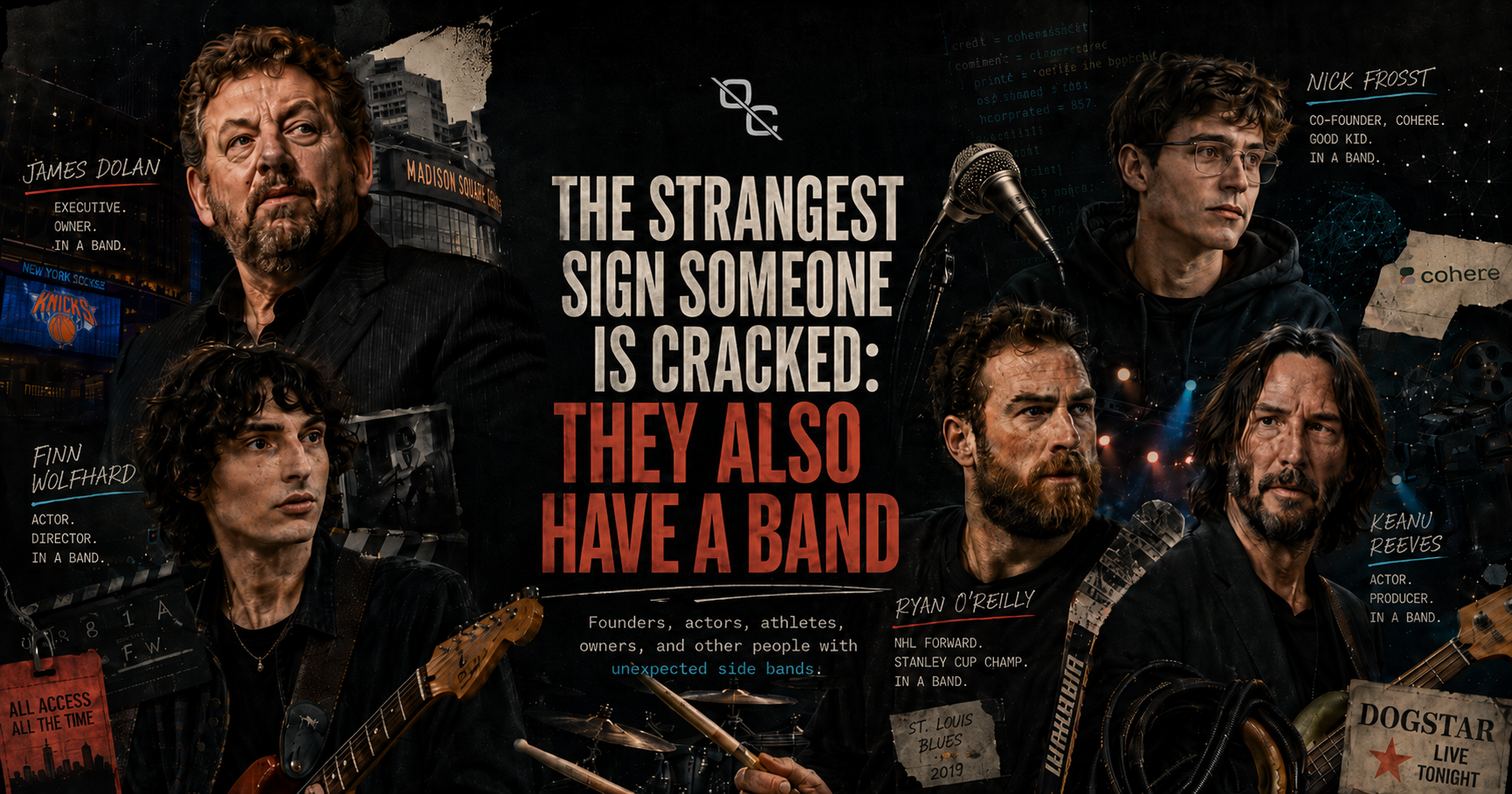
Some people get good at one thing. A smaller, stranger group gets elite at one thing, then casually reveals they also have a band.
“A band is timing, listening, repetition, taste, and community. You cannot fully control it. You have to fit inside it.”
Not a playlist. Not a one-off studio session. A real band. Rehearsals. Tour dates. Group photos. Weird song titles. The whole thing.
There is a very specific type of person who ends up here. They are already known for something completely different: building AI companies, owning sports teams, winning Stanley Cups, acting in massive shows, explaining particle physics, writing horror novels. Then, somewhere in the background, they are also playing bass, singing indie rock, writing kids songs, or fronting a blues band.
The point is not that all of them are secretly better as musicians. Some are genuinely good. Some are charming because they are not trying to be perfect. Some are simply too strange to ignore. But together, they say something interesting: the most cracked people usually need another outlet.
Nick Frosst is the most modern example. He is co-founder of Cohere and lead singer of Good Kid.
Good Kid does not feel like a founder vanity project. It is a real Toronto indie rock band with a real fanbase, real shows, and a sound that sits somewhere between internet-native indie, anime energy, and polished college-band chaos. TechCrunch reported that Frosst is the frontman of Good Kid while also working full-time at Cohere, and that the band has played Lollapalooza, opened for Portugal. The Man, and built a huge online following. Inovia’s profile of Frosst also notes that he is Cohere co-founder and Good Kid’s lead vocalist.
That is the insane part. This is not tech guy buys a guitar. This is one of Canada’s biggest AI founders is also leading a band that young fans actually care about. It works because it does not feel forced. Good Kid has its own community, its own visual world, and its own lane.
Ryan O’Reilly might be the most wholesome one.
Most people know him as an NHL center, a Stanley Cup champion, a Conn Smythe winner, and a Selke Trophy winner. The NHL’s own profile notes his Conn Smythe win after helping St. Louis defeat Boston in the 2019 Stanley Cup Final, and NHL.com also covered his Selke win that same year.
Then he moved to Nashville and somehow ended up in a children’s music duo called Mac N Cheeze with Kelly James. NHL.com described the project as a Nashville-based children’s music duo, with songs like Pizza Party and Coconut, while the NHLPA wrote that O’Reilly started playing guitar as a teenager and later began making silly songs for his kids.
It is almost too perfect. A tough two-way hockey player becomes a dad, picks up the guitar, and ends up making goofy, polished kids music. No forced cool factor. Just a very specific kind of joy.
Finn Wolfhard is a cleaner cultural fit because his music taste was always part of his public identity.
He became famous through Stranger Things and It, but he has never treated music like a random celebrity side project. He was in Calpurnia, then formed The Aubreys with Malcolm Craig. Consequence covered the launch of The Aubreys after Calpurnia ended, noting that the duo contributed music to The Turning soundtrack. The Guardian later described Wolfhard as fronting garage-rock band The Aubreys while continuing his film career.
Wolfhard is not surprising because he likes music. He is surprising because he has managed to stay tasteful while being attached to giant franchises. That is hard. Most child-star music feels like brand maintenance. His feels more like someone who actually grew up in record stores and rehearsal rooms.
Then there is James Dolan, the strangest one on the list.
Dolan is the executive chairman of Madison Square Garden Sports, the company connected to the Knicks and Rangers, and he also leads MSG Entertainment and Sphere Entertainment. He is also the person behind JD and The Straight Shot, a blues-rock band formed by Dolan, according to NBC’s Tonight Show page.
This is not a hidden hobby either. The band has played television, opened for major acts, and been written about constantly because, well, the owner of the Knicks being in a blues band is impossible not to talk about. Pitchfork even covered a lawsuit where shareholders alleged Dolan spent too much time with the band, which is probably the most James Dolan sentence ever written.
Dolan is the version of this where the music becomes part of the mythology. It is not necessarily cool. It is not necessarily uncool. It is just extremely specific.
The one you were probably forgetting is Keanu Reeves.
Before the internet fully turned him into the patron saint of being quietly decent, Reeves was already the bassist in Dogstar. The band formed in the early 1990s, took a long break, then reunited for new music and live shows. Pitchfork covered Dogstar’s reunion, noting Reeves on bass with Rob Mailhouse and Bret Domrose, and GQ has written about the band’s strange, very real place in Reeves’ career.
Reeves is the cleanest example of famous person in a band because he never seemed desperate to be the frontman. He played bass. He stood to the side. He let the band be a band. That is probably why people still find it charming.
There is also a whole lane of actors who became known on screen, then built music careers that fans actually follow.
Joe Keery, best known for Stranger Things, was in Post Animal and now releases music as Djo. The Guardian covered how Keery has built a serious music career after Stranger Things, while Pitchfork reviewed his album The Crux as part of his Djo project.
Dylan Minnette did something similar with Wallows. Teen Vogue covered Wallows first single when Minnette was breaking out through 13 Reasons Why, and Entertainment Weekly later reported that he stepped back from acting to focus on music with the band.
The difference with Keery and Minnette is that the music is no longer just a side note. It has become part of the main story.
The funniest version of this might be Professor Brian Cox.
Before he became one of the world’s most recognizable science communicators, Cox played keyboard with D:Ream, the UK pop group behind Things Can Only Get Better. The American Physical Society notes that Cox was roped in as D:Ream’s keyboardist after earlier playing with Dare.
It sounds fake, but it is real: one of the people explaining the universe on television also had a pop-band chapter. That might be the purest form of range.
Writers have their own version too. Rock Bottom Remainders is a band made up of authors including Stephen King, Amy Tan, Dave Barry, Mitch Albom, Scott Turow, and Matt Groening. Mitch Albom’s own site describes the group as a band of bestselling authors, while Oprah covered them as a rock band of writers.
This one feels less like a band trying to become famous and more like a reminder that creative people get bored staying in one format. Sometimes a novelist wants to stop typing and make noise with friends.
And then there is Macaulay Culkin and The Pizza Underground, a pizza-themed Velvet Underground cover band.
Pitchfork covered the project in 2013, describing the band as Culkin’s pizza-themed twist on Velvet Underground songs.
It is not the strongest musical case. It might not even be the best Culkin side quest. But as a cultural artifact, it belongs here. Some bands are good. Some bands are important. Some bands are just a perfect internet object.
Why does this keep happening?
The easy explanation is that famous people have access. They can afford instruments, studios, friends who produce, and rooms where people will show up.
But the better explanation is that a band gives high-performing people something their main career usually does not: a place to be one part of a group.
Actors spend their lives being watched. Athletes are measured. Founders are judged by outcomes. Owners are blamed for everything. Scientists are expected to be right. Writers are alone with their own heads.
A band is different. A band is timing, listening, repetition, taste, and community. You cannot fully control it. You have to fit inside it.
That might be why the best examples feel so human. Nick Frosst has Cohere, but Good Kid gives him a completely different room. Ryan O’Reilly has hockey, but Mac N Cheeze gives him something for his kids. Keanu Reeves has film, but Dogstar lets him stand to the side with a bass. Finn Wolfhard has global fame, but music lets him stay connected to the kind of DIY culture that made him interesting in the first place.
Being in a band is not always the most impressive thing these people do.
That is exactly why it is interesting.
Filed nearby.
- Culture
The quiet hour.
A generation has learned to recognise the moment before a movement. The room before the noise, the artist before the rollout, the city before the rebrand. A field report from inside it.
- Sports
The luxuryification of sports.
Stadiums became entertainment districts. Suites replaced cheap seats. The loudest fans were never the richest ones. A field note on what gets lost when sport becomes too nice.
- Culture
Notes From A Room That Doesn T Want To Be Named.
Filed quietly. Read closely. A field note from the room before the noise.
- Culture
Why The Next Stadium Tour Will Start In A 200 Cap Room.
Filed quietly. Read closely. A field note from the room before the noise.
0 comments
Be the first to comment.