
The Prediction Market Is Faking the Culture it Claims to Measure.
Speculative betting on Spotify charts has turned the act of listening into a financial instrument for the new rationalist class.
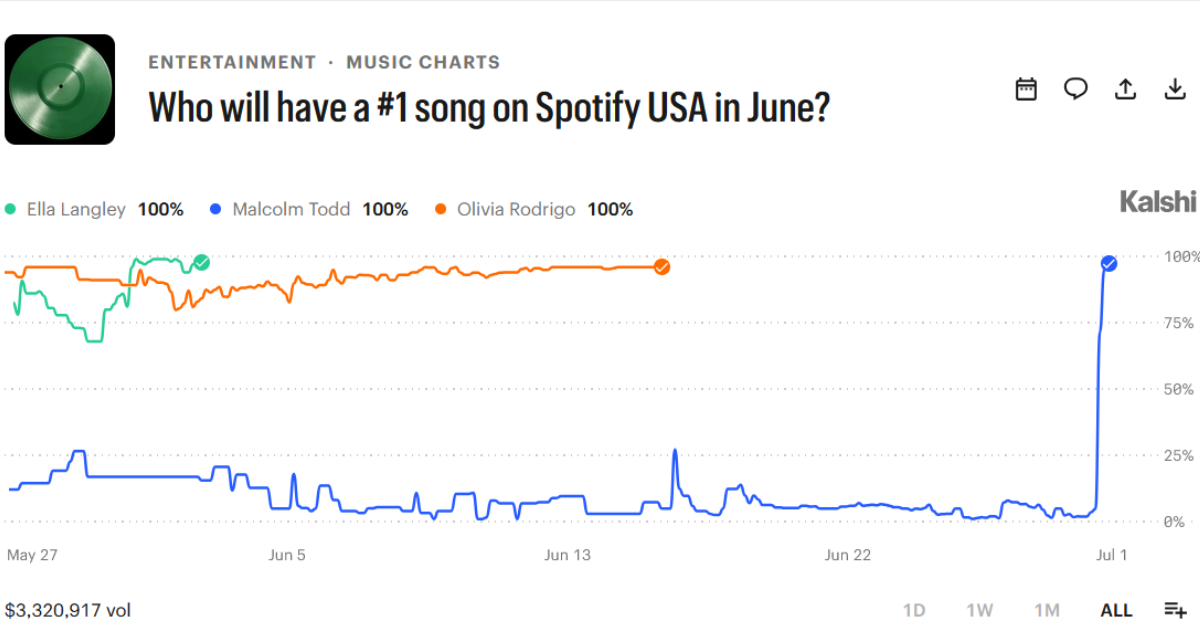
A server rack in a cooling room hums with the same intensity as a betting floor in Reno. The data points flickering across the dashboard suggest that Malcolm Todd, a musician of modest indie-pop reach, suddenly commanded the undivided attention of half a million new American listeners in a single afternoon. These are not fans, but ghosts summoned by a script.
“When a streaming number is no longer just a tally of attention but a payout trigger, the incentive to listen is replaced by the incentive to distort.”
The spike in June statistics for the track Earrings was eventually scrubbed by Spotify after being identified as a systematic manipulation attempts, per Garbage Day. The incident marks a shift where the metric itself becomes a target for arbitrage. When a streaming number is no longer just a tally of attention but a payout trigger, the incentive to listen is replaced by the incentive to distort.
Cultural metrics were already fragile, but they remained grounded in a desire for status or visibility. The entry of Kalshi into the music space changes the gravity, introducing a cold financial motive to what was once a soft social game. We are watching the transition from vanity metrics to speculative commodities.
Spotify has historically operated with a legal stiffness that Instagram or X lacks, largely because it was built as a clean harbor for the major labels. The industry spent decades litigating against the chaos of early file sharing to establish a system where a play equals a fraction of a cent. For a prediction market trader, that fraction of a cent is irrelevant compared to the payout on a win-or-loss contract.
Gaeten Dugas, a prominent voice in the Kalshi community, was among the first to flag the suspicious Malcolm Todd numbers. The irony is that the platforms built to provide clarity on the future are now creating the very fog they claim to disperse. By betting on what the data will say, traders are incentivized to ensure the data says exactly what they need it to.
This behavior is born from the rationalist circles of the Bay Area where everything is a market and every market is an opportunity for optimization. The philosophy suggests that if a system can be gamed, it should be, as a way of proving its inherent flaws. The casualty in this particular experiment is a sense of shared reality regarding who is actually popular.
The legal consequences for streaming fraud are real, evidenced by recent criminal convictions in Denmark and the United States involving bot farms. Yet the prediction market exists in a regulatory gray zone that makes traditional enforcement feel sluggish. While a judge might understand wire fraud, the concept of mindshare arbitrage is harder to fit into a sentencing guideline.
A skeptic might argue that charts have always been manipulated by powerful radio pluggers and major label marketing budgets. The difference now is the democratization of the fix, where any trader with a botnet can attempt to move the needle. The top-down control of the record industry has been replaced by the lateral chaos of the prediction desk.
Spotify is now reportedly distancing itself from Kalshi, stripping its branding from the betting site to protect the integrity of its walled garden. It is a defensive move intended to preserve the illusion that a number 1 song reflects a collective human preference. Once the numbers are untethered from human ears, the platform loses its primary value as a cultural authority.
The music industry is accustomed to fighting pirates, but it is less prepared to fight mathematicians. In this new arrangement, the song is merely a ticker symbol, and the listener is an unnecessary variable in the equation. The quiet room of the recording studio has been replaced by the loud math of the exchange.
Filed via Quietly Culture. Source: Garbage Day (https://www.garbageday.email/p/inside-spotify-and-kalshi-s-messy-breakup).
Filed nearby.
- Culture
The quiet hour.
A generation has learned to recognise the moment before a movement. The room before the noise, the artist before the rollout, the city before the rebrand. A field report from inside it.
- Sports
The luxuryification of sports.
Stadiums became entertainment districts. Suites replaced cheap seats. The loudest fans were never the richest ones. A field note on what gets lost when sport becomes too nice.
- Culture
Notes From A Room That Doesn T Want To Be Named.
Filed quietly. Read closely. A field note from the room before the noise.
- Culture
Why The Next Stadium Tour Will Start In A 200 Cap Room.
Filed quietly. Read closely. A field note from the room before the noise.
0 comments
Be the first to comment.