The New Stage is Vertical
This is the most important creative shift in vertical content.
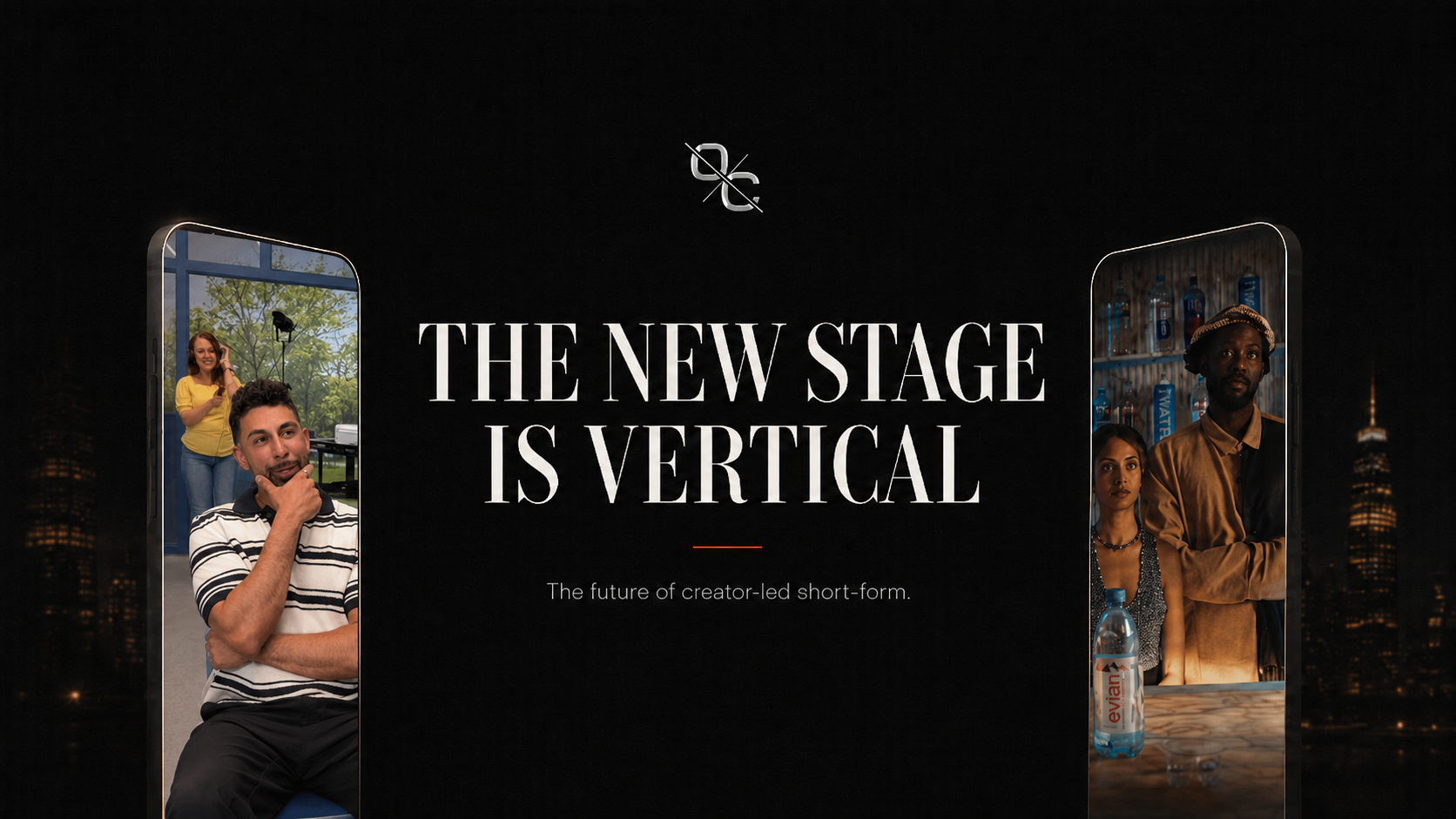
The New Stage Is Vertical
There is a strange new sign of cultural power: people who do not need the exposure are starting to show up in creator-made vertical shows.
Not cameos in a traditional sense. Not awkward brand partnerships. Not the old celebrity social post where someone shows up, smiles, mentions the product, and leaves.
They are walking into creator-built worlds.
That is what makes Brooklyn Coffee Shop so interesting. The show, created and written by Pooja Tripathi, is a fictional hipster coffee shop where customers enter with some recognizable social type attached to them, then get quietly destroyed by the baristas. Vogue India described it as an internet hit where every coffee order turns into social commentary, with Tripathi’s character Thyme playing the permanently unimpressed barista behind the counter. (Vogue India1)
The format is simple enough to understand in three seconds. Someone walks in. The baristas clock them. The social critique begins.
But the reason it matters is bigger than the joke. Brooklyn Coffee Shop has started attracting guests who do not desperately need the screen time. IMDb credits for the series include appearances from Becky G, Ryan Serhant, Padma Lakshmi, Whitney Cummings, and others, alongside Pooja Tripathi as writer across 90 episodes. (IMDb2)
That is the shift. The creator is no longer borrowing celebrity energy. The celebrity is borrowing the creator’s world.
The phone became the new stage
For years, short-form content was treated like the top of the funnel. A clip could sell a song, tease a podcast, promote a movie, push someone to YouTube, or remind people a show existed somewhere else.
That is changing.
Vertical video is becoming the thing itself. Not a trailer. Not a cutdown. Not a marketing afterthought. A real performance space with its own pacing, stars, formats, writing rules, and audience expectations.
The proof is not just cultural. It is structural. Sensor Tower reported that global in-app revenue from short drama apps reached almost $700 million in Q1 2025, nearly four times higher than Q1 2024. It also reported nearly 950 million cumulative downloads for short drama apps by March 2025. (Sensor Tower3)
The United States is not sitting outside this shift either. Sensor Tower found that the U.S. accounted for 49% of global short drama app revenue in Q1 2025, while Latin America, Southeast Asia, and India showed fast download growth. (Sensor Tower3)
This is not just “people watch TikToks now.” It is a new entertainment format being professionalized in real time.
Dhar Mann built the global grammar
Dhar Mann is the clearest bridge between old social video and the next version of vertical scripted content.
His work has never been subtle. That is part of why it travels. The characters are easy to read. The conflict starts immediately. The emotional lesson is clear. The titles sound like internet folk tales. The worlds are broad enough to survive dubbing, clipping, remixing, and distribution across multiple platforms.
Dhar Mann Studios says its videos receive more than 1 billion views monthly and have passed 100 billion views across Facebook, YouTube, Instagram, and TikTok. The studio also claims a global audience of more than 160 million social followers. (LinkedIn4)
That kind of reach explains why traditional media is now coming toward him, not the other way around. In January 2026, Dhar Mann Studios, Fox Entertainment, and Holywater announced a multi-year global vertical video deal for an initial 40-title slate designed for Holywater’s My Drama app, with Fox handling worldwide distribution windows. (holywater.tech5)
Samsung TV Plus also announced Unlikely Romances, executive produced and written by Dhar Mann, as its first creator-led original scripted series. The series was set to premiere across several countries, including the U.S., Canada, Australia, France, Germany, Portugal, Sweden, and Switzerland. (Samsung Global Newsroom6)
This is the key distinction: Dhar Mann is not just a creator who went viral. He built a story machine that traditional platforms can plug into.
His format is almost anti-prestige. It is direct, emotional, repetitive, and extremely legible. That makes it easy to dismiss, but also easy to scale. In a global vertical ecosystem, legibility matters. A story that can be understood with the sound off, translated quickly, and felt without cultural footnotes has an obvious advantage.
Dhar Mann is not making Brooklyn-specific satire. He is making global moral shorthand.
Pooja Tripathi is building the North American social sitcom
Brooklyn Coffee Shop works for the opposite reason.
It is specific. Almost aggressively specific. The show understands the accents, costumes, micro-status signals, food politics, dating language, therapy words, wellness codes, and fake-progressive etiquette of a very online North American audience.
Pooja Tripathi’s site says she created Brooklyn Coffeeshop in 2022 as a sketch series about two disgruntled baristas interacting with customers in a hipster coffee shop, and that the show has passed 50 million total views across Instagram and TikTok. (Pooja Tripathi7)
Vogue India notes that each episode is approximately a minute long, and Tripathi herself has said social platforms made the show possible because traditional media requires “so many people to say yes.” (Vogue India1)
That line explains the whole shift.
The old path was permission-based. Write the pilot. Get the meeting. Wait for development. Find the buyer. Cast it. Test it. Hope it survives.
The new path is world-first. Build the set. Build the voice. Build the characters. Let the audience prove the demand before anyone in a boardroom understands it.
Brooklyn Coffee Shop feels like SNL for the social age, but with one important difference. SNL bends every week around the guest host. Brooklyn Coffee Shop does not. The guest enters the show’s world and gets treated like everyone else.
That is why the appearances feel strong. Ryan Serhant does not show up as a protected celebrity cameo. He shows up as a type. Becky G does not require the format to become a music promo. The coffee shop remains the coffee shop.
The world is the star. The guest is the episode.
The format is becoming more powerful than the person
This is the most important creative shift in vertical content.
For a long time, short-form rewarded personality. The creator was the format. A person talked to camera, reacted to something, danced, reviewed, explained, ranked, vented, or performed a recurring bit.
Now the strongest creators are building formats that can outlive any single upload.
A vertical format has to do several things at once. It needs to be instantly understandable. It needs repeat characters or repeat rules. It needs enough flexibility to accept guests, brands, references, and topical moments. It needs a visual world that people recognize before reading the caption. It needs a reason to keep returning beyond one joke.
Brooklyn Coffee Shop has the counter.
Dhar Mann has the moral parable.
ReelShort and DramaBox have the cliffhanger machine.
Kountry Wayne has the high-volume serialized universe. AP reported that he releases 50 episodes a day and chose to keep control as Hollywood interest in vertical storytelling accelerated. (AP News8)
This is not just content creation. It is format ownership.
The future belongs to creators who can build a room other people want to enter.
Hollywood noticed after the audience already moved
The funny thing about vertical scripted content is that it was dismissed until it became too large to ignore.
AP reported that global microdrama revenues are expected to hit $14 billion by the end of 2026, according to Omdia estimates. The same report notes that Peacock launched a microdrama hub, Fox invested in Holywater, TelevisaUnivision began producing serialized short-form dramas for ViX, HartBeat expanded into vertical comedy, and Kim Kardashian backed scripted mobile-first content through ReelShort. (AP News8)
WWE is also entering the space. In July 2026, ReelShort and WWE announced a live-action microdrama partnership, calling it the first collaboration between a major sports and entertainment brand and a microdrama platform. (corporate.wwe.com9)
That detail matters because WWE already understands serialized vertical logic better than most traditional studios. It has heroes, villains, rivalries, cliffhangers, recurring worlds, and fan-driven mythology. Moving that into microdrama is not a stretch. It is almost too obvious.
The bigger surprise is that Hollywood is still treating vertical like a new format, when audiences have already accepted it as a normal screen.
Why celebrities are showing up
Celebrity cameos used to happen in places that signaled legitimacy: late-night TV, SNL, prestige cable, music videos, blockbuster franchises.
Now cultural legitimacy can come from a creator’s world.
There are a few reasons.
First, vertical shows are fast. A celebrity can step into a one-minute episode and get a cleaner cultural hit than a full press tour clip.
Second, the audience is already there. The creator does not need to borrow distribution from a network. The show lives where the audience is already scrolling.
Third, self-awareness performs well. A celebrity being gently roasted by a creator can feel more human than a polished interview.
Fourth, creators have trust that brands and studios often do not. Their worlds feel native to the feed. The best ones do not look like ads, even when they clearly know how to carry attention.
And finally, the format lowers the stakes. A guest can play a heightened version of themselves, survive the joke, and leave looking more culturally fluent than before.
This is why Brooklyn Coffee Shop’s guest list feels like a signal. Not because every appearance is massive. Because the format gives guests something traditional media often cannot: a believable reason to be there.
The overseas version and the North American version are splitting
Vertical scripted content is not one thing.
The overseas version, especially in China-born microdrama culture, is built around volume, cliffhangers, emotional extremes, paywalled episodes, and fast localization. The story engine is often romance, revenge, betrayal, family status, secret wealth, mistaken identity, or survival. It is soap opera logic compressed into phone-native chapters.
The North American creator version is often more social than melodramatic. It is sketch, satire, character, and vibe. It is less about “what happens next” and more about “I know this person.” Brooklyn Coffee Shop works because viewers recognize the customer before the customer explains themselves.
Dhar Mann sits between the two. His content has the moral clarity and global portability of international vertical drama, but the creator-led infrastructure of American social media.
Pooja sits closer to the future of creator comedy. Her work is not just made for the phone. It is made out of phone culture.
That distinction will define the next few years.
What comes next
The future of vertical short-form content probably looks less like random viral posts and more like a set of small, durable worlds.
More creators will build recurring locations: coffee shops, offices, gyms, salons, apartments, studios, classrooms, therapy rooms, clubs, restaurants, group chats brought to life.
More celebrities will appear inside those worlds because it is culturally efficient.
More brands will stop asking for product placement and start asking to become part of the story structure.
More vertical actors will become recognizable before traditional casting directors know what to do with them.
More studios will try to buy or copy creator formats, then learn that the format only works when the voice is intact.
More shows will be written with localization in mind from the beginning.
And more young creators will skip the pilot system entirely.
That does not mean every vertical series will be good. A lot of it will be cheap, over-written, aggressively optimized, and emotionally obvious. The cliffhanger economy can flatten taste quickly. If every episode is engineered only to stop the thumb, the whole format becomes noise.
But the best version of this shift is exciting.
It gives writers a stage without waiting for permission. It gives performers a place to build characters in public. It gives celebrities a new kind of cultural fluency. It gives audiences shows that feel alive because they can respond, remix, comment, and watch the world evolve in real time.
The next great sitcom might not start in a writers’ room.
It might start behind a fake coffee counter, on a phone, with a customer walking in and the audience already knowing exactly who is about to get cooked.
- 1.The viral internet coffee shop where every order is a social critique | Vogue India
- 2.Brooklyn Coffee Shop (TV Series 2023– ) - Full cast & crew - IMDb
- 3.State of Short Drama Apps 2025 Report
- 4.Dhar Mann Studios | LinkedIn
- 5.DHAR MANN STUDIOS, FOX ENTERTAINMENT AND HOLYWATER ANNOUNCE LANDMARK MULTI-YEAR, GLOBAL VERTICAL VIDEO DEAL
- 6.Samsung TV Plus Exclusives Unveils Trailer for its First Original Scripted Series, Unlikely Romances Presented by Dhar Mann Studios
- 7.Pooja Tripathi - About - Pooja Tripathi
- 8.Hollywood gets into microdramas as stars and studios invest | AP News
- 9.REELSHORT AND WWE® PARTNER TO BRING ORIGINAL LIVE-ACTION MICRODRAMA TO FANS WORLDWIDE | Corporate
Filed nearby.
- Culture
The quiet hour.
A generation has learned to recognise the moment before a movement. The room before the noise, the artist before the rollout, the city before the rebrand. A field report from inside it.
- Sports
The luxuryification of sports.
Stadiums became entertainment districts. Suites replaced cheap seats. The loudest fans were never the richest ones. A field note on what gets lost when sport becomes too nice.
- Culture
Notes From A Room That Doesn T Want To Be Named.
Filed quietly. Read closely. A field note from the room before the noise.
- Culture
Why The Next Stadium Tour Will Start In A 200 Cap Room.
Filed quietly. Read closely. A field note from the room before the noise.
0 comments
Be the first to comment.