
Airtable Sold Because The Spreadsheet Became A Prompt
Airtable did not sell because it had no business. It sold because the story around the business changed.
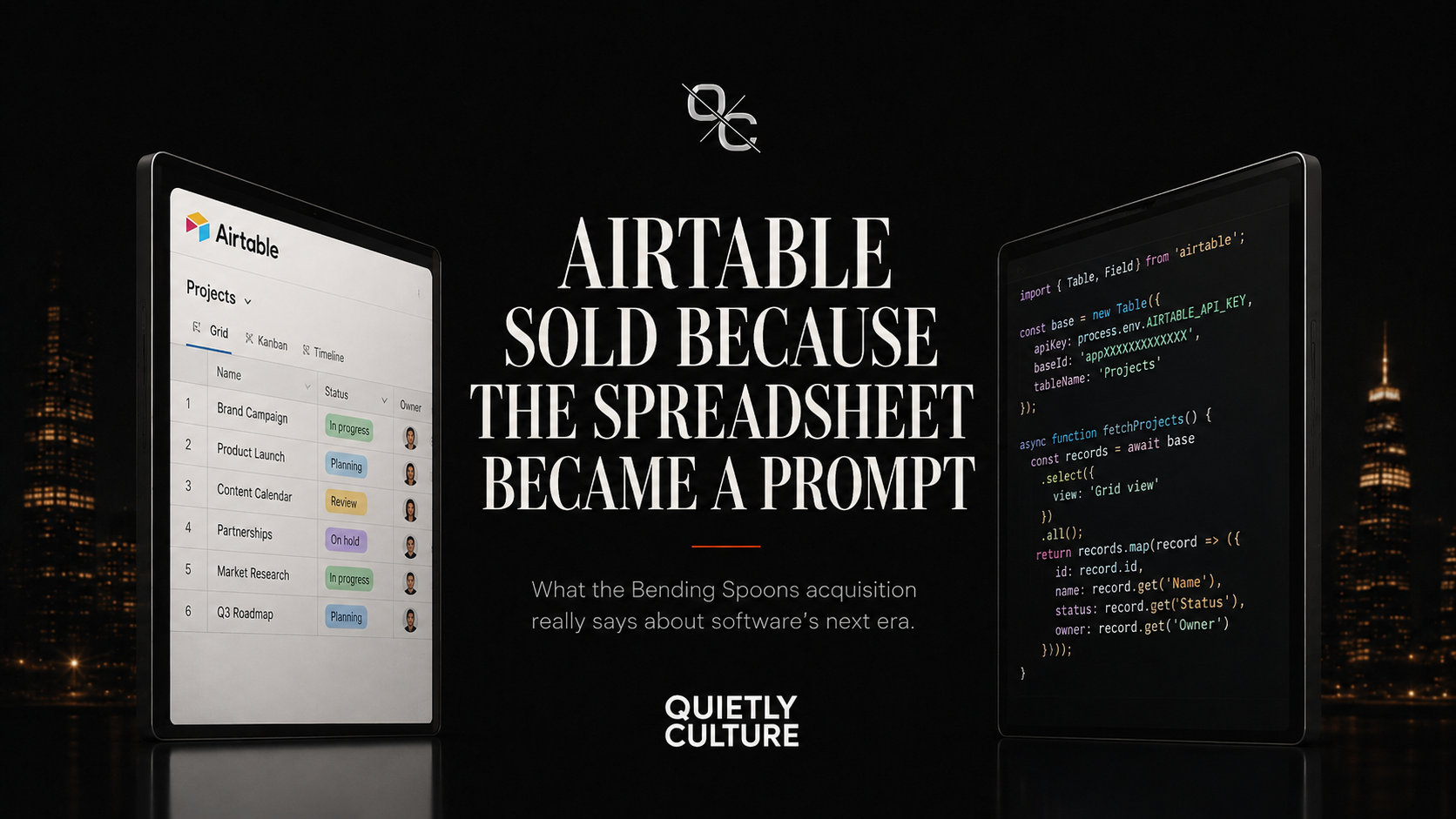
Bending Spoons is acquiring Airtable for an all-in price of $2.25 billion.
At first glance, that sounds like a healthy outcome.
Then you look closer.
Airtable reportedly has roughly $965 million of cash on its balance sheet, meaning the actual enterprise value of the deal is closer to $1.285 billion.[1]
For a company doing around $480 million in annual recurring revenue and still growing more than 20% year over year, that works out to roughly 2.7x revenue.[1]
Five years ago, that number would have been unthinkable.
In 2021, Airtable raised capital at an $11.7 billion valuation and was viewed as one of the defining software companies of its generation.[2]
So the question isn't why Bending Spoons bought Airtable.
The real question is why Airtable sold.
The world changed underneath them
For most of the last decade, Airtable represented something bigger than a spreadsheet.
It promised a world where anyone could build software.
Marketing teams could create workflows. Agencies could spin up client portals. Startups could launch internal tools in days instead of months.
The pitch was compelling because traditional software development was slow, expensive, and inaccessible.
Why hire engineers when you could open Airtable and have a working system by Friday?
That logic powered one of the most important software categories of the last decade.
Then AI-assisted engineering arrived.
Suddenly, the alternative wasn't spending six months building custom software.
The alternative was opening Claude, Codex, Cursor, or Lovable and generating a custom application over a weekend.
The equation changed almost overnight.
The spreadsheet became a prompt
The uncomfortable reality for no-code companies is that their original promise was speed.
AI makes everything faster.
Five years ago, the question was simple:
Why build custom software when Airtable already exists?
Today, the question is becoming:
Why squeeze your workflow into Airtable when AI can generate exactly what you need?
That does not mean AI-generated software is better.
It usually isn't.
But it does mean that the core value proposition of many no-code tools has fundamentally shifted.
The easy parts of Airtable are becoming easier to replicate.
That distinction matters.
A project tracker, content calendar, CRM, or lightweight internal dashboard can increasingly be generated by a model.
The hard part was never building the interface.
The hard part was organizing people.
The middle is disappearing
Airtable sits in a difficult position.
It's more powerful than a spreadsheet.
It's easier than traditional development.
For years, that middle ground was incredibly valuable.
Today, it's being squeezed from both sides.
At the bottom, AI coding tools are making custom software dramatically cheaper.
At the top, companies like Microsoft, Google, Salesforce, and ServiceNow already own the infrastructure layer of enterprise software.
The middle layer suddenly looks vulnerable.
Ironically, Airtable's original mission may be coming true.
The company wanted to democratize software development.
AI is democratizing software development.
The catch is that it may not happen through Airtable.
Why didn't Google buy it?
This might be the biggest signal in the entire deal.
Five years ago, an acquisition by Google, Microsoft, or Salesforce would have been viewed as validation.
Today, none of them appear particularly interested.
That says something important.
Every major software company now believes it can build its own AI-native workflow platform.
Microsoft has Copilot.
Salesforce has Agentforce.
Google has Gemini.
No company needs Airtable the way they might have in 2021.
Useful is no longer enough.
Software companies increasingly need to become infrastructure.
Maybe Bending Spoons sees something everyone else doesn't
The bearish interpretation is obvious.
Airtable missed the AI shift.
The category collapsed.
The company ran out of options.
But there is a bullish interpretation too.
Inside every Airtable workspace lives something incredibly valuable: structured data about how organizations actually operate.
Product roadmaps.
Content calendars.
Hiring pipelines.
Marketing campaigns.
Vendor relationships.
Customer feedback.
Operational systems.
In an AI world, that information becomes more valuable, not less.
Agents need context.
Agents need permissions.
Agents need workflows.
Agents need structured data.
Perhaps Bending Spoons isn't buying a no-code tool at all.
Perhaps it's buying the operating system for AI workers.
The problem wasn't the product. It was the narrative.
A company with nearly half a billion dollars in recurring revenue and close to a billion dollars in cash did not fail.
What changed was the story.
In 2021, investors believed Airtable would become one of the dominant ways software was built.
In 2026, investors appear to believe software itself is becoming abundant.
That changes how the market values flexibility.
When software is difficult to create, platforms like Airtable become incredibly valuable.
When software becomes easy to create, the value shifts elsewhere.
Trust.
Governance.
Distribution.
Data.
Reliability.
The winners of the next decade won't be the companies that make it easiest to start.
They'll be the companies that become impossible to replace once the work gets serious.
The deeper signal
This acquisition isn't really about Airtable.
It's about what happens during platform shifts.
Spreadsheets became databases.
Databases became no-code apps.
No-code apps are becoming prompts.
Prompts are becoming agents.
Every transition destroys value somewhere and creates value somewhere else.
The question isn't whether AI will replace software.
The question is which layer of the stack gets compressed next.
Airtable was once the obvious answer because software was hard to build.
The next era may belong to whoever becomes the obvious answer because work is still hard.
According to **Bending Spoons**1, Airtable had approximately $480 million in annual recurring revenue as of June 2026.
In 2021, **Axios**2 reported that Airtable raised capital at an $11.7 billion valuation.
Filed nearby.
- Culture
The quiet hour.
A generation has learned to recognise the moment before a movement. The room before the noise, the artist before the rollout, the city before the rebrand. A field report from inside it.
- Sports
The luxuryification of sports.
Stadiums became entertainment districts. Suites replaced cheap seats. The loudest fans were never the richest ones. A field note on what gets lost when sport becomes too nice.
- Culture
Notes From A Room That Doesn T Want To Be Named.
Filed quietly. Read closely. A field note from the room before the noise.
- Culture
Why The Next Stadium Tour Will Start In A 200 Cap Room.
Filed quietly. Read closely. A field note from the room before the noise.
0 comments
Be the first to comment.